Lift visual features to 3D
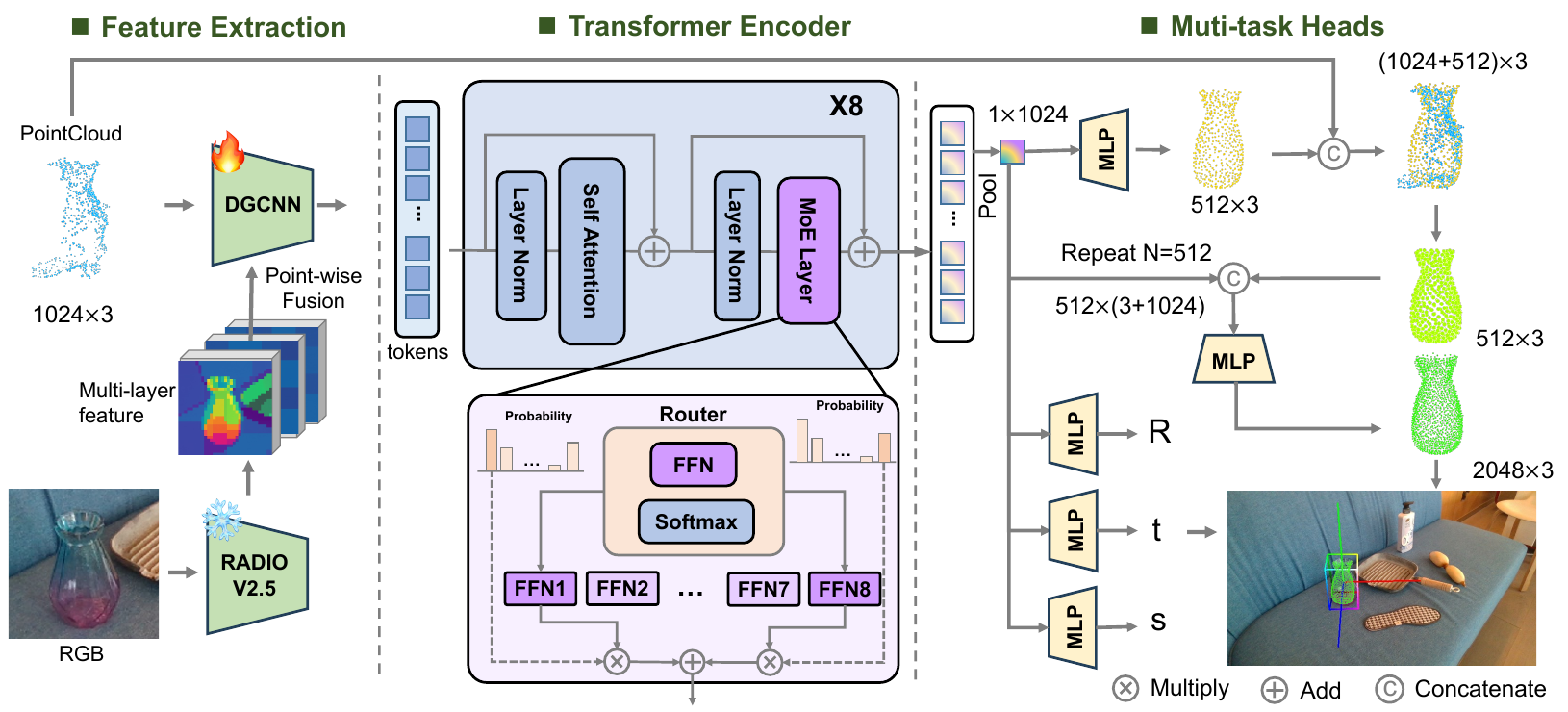
A frozen RADIO backbone extracts dense image features. Aligned depth and the object mask associate those features with observed 3D points.
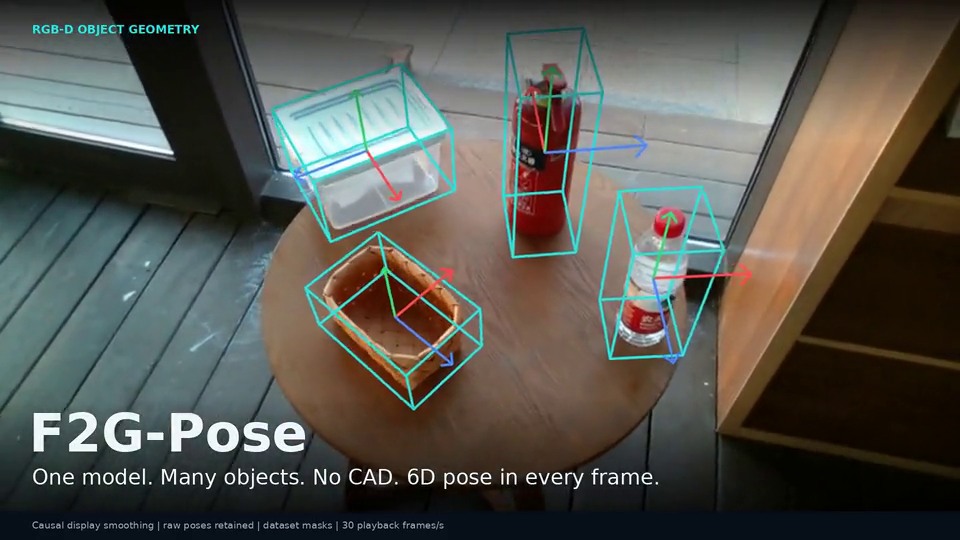
From one segmented RGB-D observation, directly predict 6D pose, metric size, and camera-frame completed shape.
1 Fudan University 2 Shanghai
Innovation Institute
* Equal contribution † Corresponding author
01 — METHOD
F2G-Pose uses the observed RGB-D geometry and dense visual features together. Its two output branches share one learned representation.
A frozen RADIO backbone extracts dense image features. Aligned depth and the object mask associate those features with observed 3D points.
DGCNN builds local geometric tokens; a Mixture-of-Experts Transformer brings in object-level context.
Parallel heads produce the 6D pose and metric size, plus a completed point cloud in the camera frame.
02 — FILM
Real and synthetic scenes, pose comparisons, three selected shape predictions, and recorded robot cases.
03 — SELECTED EXAMPLES
ROPE / COMPARISON
Two pose overlays on the same frames from ROPE scene 000300.
ROPE / SCENE 000354
Frame-wise predictions for a donut, helmet, pineapple, rice cooker, and teapot.
ROPE / SCENE 000064
Six everyday categories in another continuous ROPE interval.
ROPE / MATERIALS
Selected transparent red wine glass and specular dish cases.
SOPE / ERASER
SOPE / CHINESE CHESS
SOPE / FLUTE
RECORDED ROBOT SCENES
Mug and cup, hammer, and transparent bottle cases.
AUC values are percentage points. Throughput is model inference on the paper’s hardware and protocol; the film’s 30 FPS playback is separate.
05 — READ & BUILD
Find the complete method, evaluation details, installation instructions, and pretrained checkpoint.